
Conical Laser Power Probes
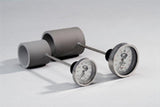 Conical Head Power Probes are used to measure high power density CO2 laser beams which may damage the standard flat surfaced Power Probes. The conical absorbing cavity exhibits a high heat dissipation.
There are two models of Conical Power Probes: C2K, C4K and C10K. Table 1 below gives specifications for these models. Table 2 gives approximate damage threshold for both the flat surface and conical power probes.
Explanation of Damage Threshold
High power lasers that can cut metal can also damage the absorbing head of a power probe if the beam is too concentrated. It has been found that it is not possible to quote a single number for the power density that will damage a power probe. The damage threshold is also a function of the total power in the beam and whether the absorbing head is moved during the exposure.
For a CO2 laser, there is no loss in absorbtivity (no damage) when the coating is heated to the point where it exhibits a visible bleached spot but no other change. There is damage when metallic areas can be seen on the surface. In operation, power densities should be kept substantially below the indicated damage threshold.
Table 1: Conical Power Probe Specifications
|
Specifications |
Model |
Model |
Model |
|---|---|---|---|
|
Primary Power |
200-2,000 (20 sec) |
400-4,000 (20 sec) |
1,000-10,000 (10 sec) |
|
Alternative Power |
NA |
NA |
500-5,000 (20 sec) |
|
Absorbing Head |
Dia: 6.2cm (2.4") |
Dia: 7.0cm (2.75") |
Dia: 7.6cm (3") |
|
Weight - gm |
535 |
1000 |
1160 |
|
Accuracy |
+/-5% |
+/-5% |
+/-5% |
|
Repeatability |
+/-1.5% |
+/-1.5% |
+/-1.5% |
Table 2: Approximate Damage Threshold
|
Power |
Time (2) |
Flat |
Conical |
|---|---|---|---|
|
100 |
20 |
10,000 |
15,000 |
|
200 |
20 |
7,000 |
11,000 |
|
500 |
20 |
4,000 |
8,000 |
|
1,000 |
20 |
2,500 |
5,000 |
|
2,000 |
20 |
1,500 |
3,000 |
|
5,000 |
20 |
1,100 |
2,200 |
|
10,000 |
10 |
900 |
1,800 |
*Moving the probe during exposure will increase (up to double) the damage threshold compared to the numbers shown for a stationary probe. To achieve this increase, the head must be moved in a circular motion so that the laser beam does not strike any one area continuously for more than 1.5 seconds.
- Power (watts) in a CO2 laser beam.
- Exposure time of the laser beam on a power probe head which is rated to accept the indicated power level.
- Approximate damage threshold for P500C, P1000C, P2000C, P10KC, H3C, and H4C.
- Approximate damage threshold for C2K, C4K and C10K conical power probes.