
Digital Laser Power Probe Information
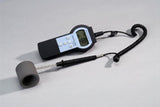 The Macken Instruments, Inc., Digital Laser Power Probe is a completely portable, easy-to-use calorimeter type power meter. The instrument consists of two components: a microprocessor-based digital meter and a probe head.
Different probe heads are available to cover various laser types with power ranges from a few watts to over 11 kW. The meter accepts any of the probe heads so it is easy to change power ranges as well as check a reading using a second probe head of the same type.
Like Macken Instruments’ highly successful dial type Analog Laser Power Probes, the Digital Power Probe uses timed exposures and is based on the idea that the laser power measurement should be quick and easy. Setup should not require special fixture or time consuming alignment. Ideally, it should be possible to take power measurements at any point in the optical system where losses are likely to occur.
Unfortunately, most laser power meters have sacrificed ease of use to gain continuous power readings. In most laboratory and production situations; however, the usual requirement is for quick power spot checks with minimum disruptions.
The Digital Power Probe has several special features. They are:
- Increased accuracy due to the microprocessor control and a digital readout. The meter automatically compensates for non-linearities and other sources for error in power measurement.
- Laser power readings are retained until the meter is reset.
- Power Probe Heads are inexpensive and easily switched. This permits alternating between two Probe Heads so that readings can be made using one head while the other cools or if the user is checking more than one different laser.
- The Digital Power Probe measures laser power with full accuracy from 20W to over 11kW using 8 Probe Heads with overlapping ranges.
- A computer chip in the Power Probe Head that contains the calibration information which allows the user to utilize the nominal 20 second exposure or the timer on the DM5 Meter for the exact calibration time.
Probe Head Selection
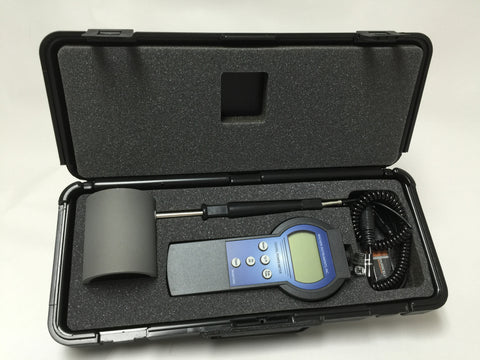
Eight different Probe Heads are available for use with the DM5 Digital Meter. The Probe Heads have four different power ranges (designated D1, D2, D3, D4). The Probe Heads are also available with two absorbing coatings designated Y and C.
The Y series Probe Heads have a broad spectral absorption coating that is particularly useful for YAG lasers but covers a spectral range from 0.4 to 6 microns. This coating can also be used with CO2 lasers.
If the Probe Head is to be used with only a CO2 laser, then the C coating is preferred. The C coating does not exhibit damage until the aluminum substrate is close to melting. The D3C and D4C Probe Heads are conical in shape allowing for a higher damage threshold.
|
Probe Head |
||||
|
Useful power range |
20 |
100 |
200 |
1000 |
|
Exposure time |
20 Sec |
20 Sec |
20 Sec |
10 Sec |
|
Resolution |
0.1 W |
1 W |
1 W |
10 W |
|
Head Diameter |
1.5” C |
1.9” C |
2.4” C |
3” C |
|
Head Length |
0.5 “ C |
2.0 “C* |
2.3” C* |
3.5” C* |
|
Accuracy |
± 5% |
± 5% |
± 5% |
± 5% |
|
Repeatability |
± 1.5% |
± 1.5% |
± 1.5% |
± 1.5% |
|
NIST Certificate |
Upon request |
Upon request |
Upon request |
Upon request |
* D2C, D3C, and D4C probe heads are conical
** YAG probes are also acceptable for CO2 lasers