![]() |
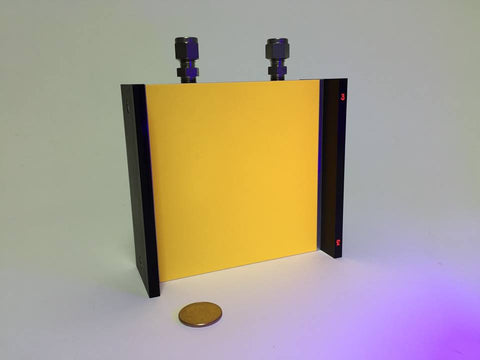
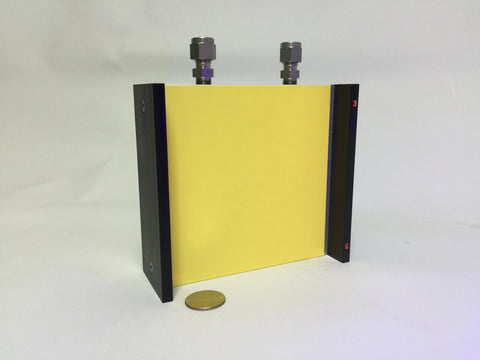
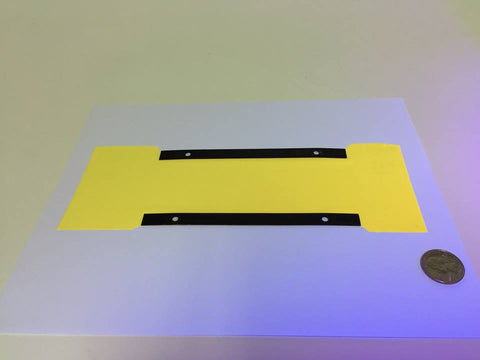
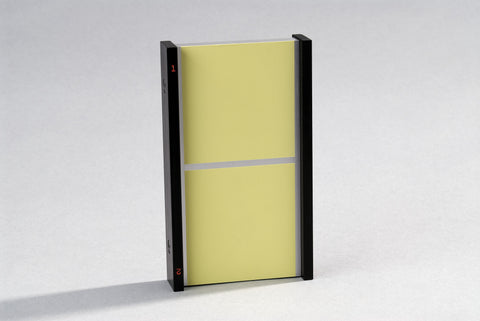
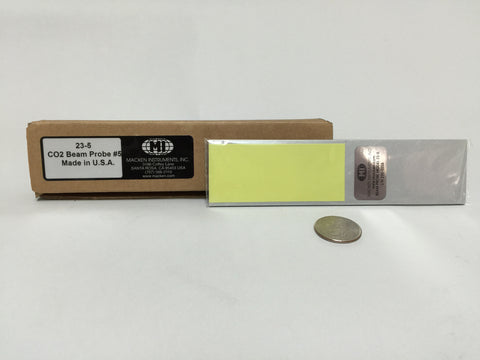
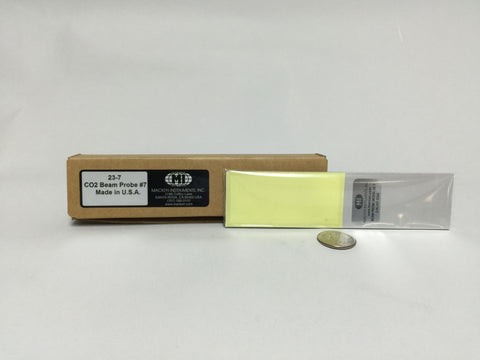
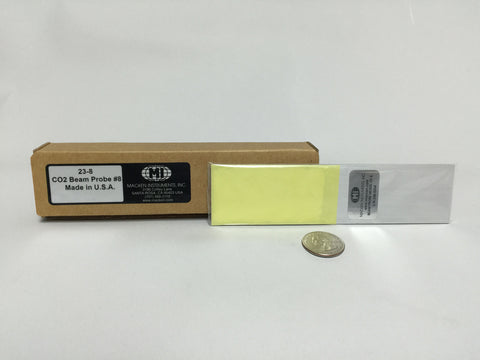
No longer are the firebricks and smoldering paper "tools of the trade" for researchers working with CO2 lasers. Now it's possible to see IR laser beams in real time and with high resolution using a Thermal Image Plate from Macken Instruments. The characteristics of this instrument enable to solve a wide range of problems. For example:
|
|
Theory of Operation
|
|
| Model Number |
Surface Number |
Normal Sensitivity Range (a) w/cm2 |
Minimum Power Density (b) w/cm2 |
Damage Threshold (c) w/cm2 |
Response Time (d) sec. |
Resolution (a) lines/in. |
Fluorescent Color |
|---|---|---|---|---|---|---|---|
|
22-A |
1 |
60-200 |
16 |
800 |
.03 .03 .03 .03 |
300 |
yellow |
|
22-B |
5 |
3.3-11 |
0.9 |
100 |
0.06 |
100 |
yellow |
| a. The normal sensitivity range is the spread of power densities which can be easily viewed with
no reduction in background illumination. The upper power density occurs when the surface becomes saturated, turning
the area completely black and making it incapable of displaying any further detail within the beam. b. The minimum-detectable power densities are the lowest power densities observable under the most favorable illumination levels. For this sensitivity the room lights must be dimmed and the level of ultraviolet illumination decreated to produce a dim fluorescense. c. Damage threshold is the power density which produces a permanent change in the thermal- sensitive surface. This occurs at power factors at least four times greater than saturation. Therefore, when saturation occurs, a lower sensitivity surface should be used to display the beam. d. The response time is the length of time it takes a change in the beam to be displayed as a change in the thermal image. e. The resolution of a surface is the maximum number of dark and light line pairs which can be displayed with good contrast. For comparison, the resolution of a newspaper photograph is approximately 70 lines/inch. Two C)2 laser beams intersecting at an angle of two degrees produce an 80 line/inch interference pattern. |
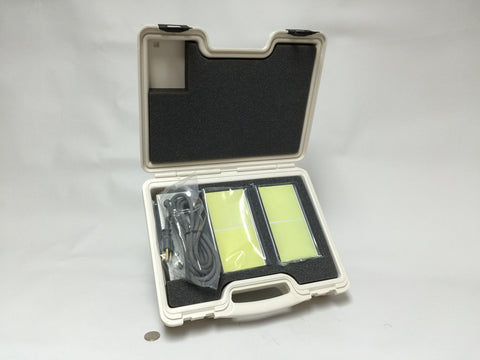
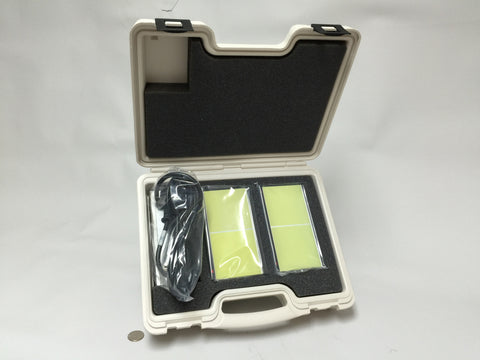
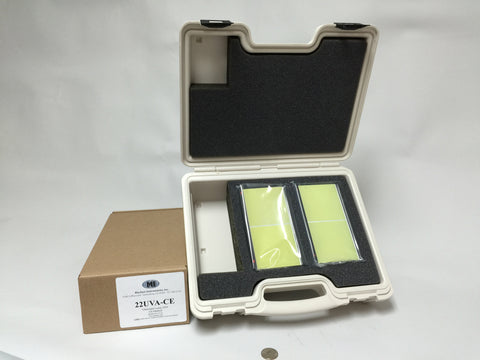
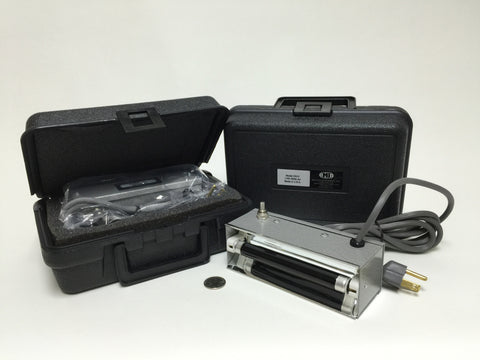
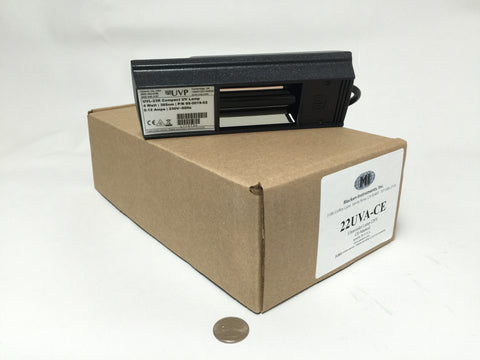
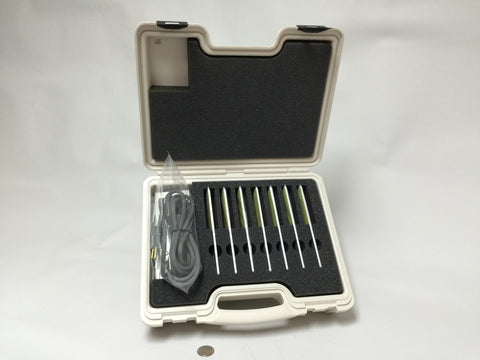
| Power Dissipation A Thermal Image Plate is capable of displaying beams up to 200 watts. However, it must be removed from the beam and allowed to cool when there is a marked decrease in overall fluorescence. This occurs when the plate has absorbed 15,000 watt seconds of power. Powers less than 30 watts can be dissipated indefinitely. Safety Precautions have been taken to eliminate specular reflections from the Thermal Image Plate. Both the thermal-sensitive surfaces and the anodized aluminum hav matte finishes and show little surface reflection at 10.6 microns. However, standard safety precautions such as wearing protective glasses should always be observed when working with IR lasers. Price The Thermal Image Plates 2--A and 22-B as well as the ultraviolet lamp 22-UV can be purchased separately or together in the form of a Thermal Image Kit. When the kit is purchased, a hard plastic case is also included. Considering the wide range of power densities which can be obtained from non-uniform beams, we recommend an initial purchase of the Thermal Image Kit. |
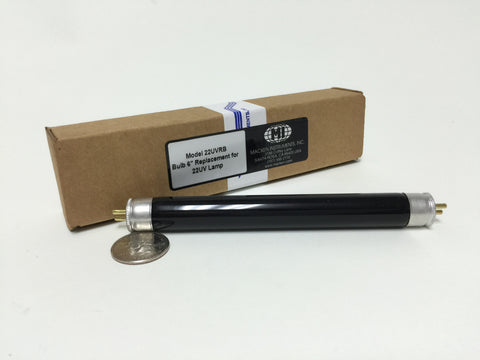
![]() Ordering Information Price List Thermal Image Plate, Model 22-A Thermal Image Plate, Model 22-B Ultraviolet Lamp, Model 22-UV Thermal Image Kit, Model 22-K -includes Model 22-A, 22-B, 22-UV, and fabric case. Prices on custom thermal image surfaces are available upon request. These include larger sizes, models or coatings applied to supplied parts. |
|
|
|